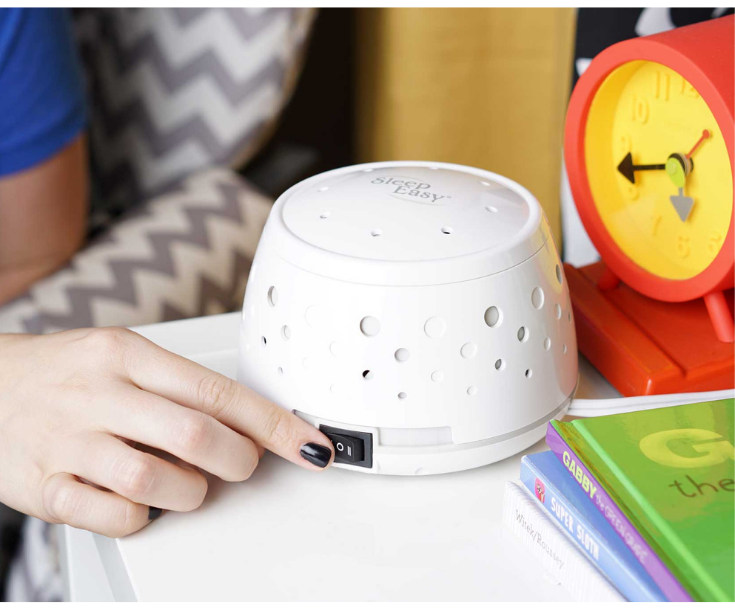
Noise machines are marketed as sleep solutions. For babies. For kids. For adults. The promise is simple: add steady sound, reduce disruption, sleep better.
Used thoughtfully, they can help. Used carelessly, they can create unintended problems.
A group of Canadian researchers measured the maximum output of several commercially available infant sleep machines. Some models, when set to full volume and placed close to a crib, produced sound levels high enough to pose a risk of hearing damage if left on for extended periods. At maximum output, nearly all of the machines tested were loud enough to disrupt sleep even when positioned across the room.
The most important takeaway from that research is simple: never use a noise machine at maximum volume.
How Loud Is Too Loud?
Background noise influences sleep quality at any age. One study found that when environmental noise reached 75 dB (roughly the level of a vacuum cleaner three feet away) two-thirds of children woke within three minutes. After twelve minutes, all had awakened.
That may sound obviously loud, but many consumer sleep machines are still made that way.
The American Academy of Pediatrics recommends that sound levels in hospital nurseries not exceed 50 dB. That’s approximately the sound of a refrigerator or dishwasher running in the next room. In a typical home environment, maintaining that level constantly may not be realistic, and some pediatricians, including Harvey Karp, have suggested that moderate white noise around 65-70 dB (similar to a soft shower) can be both safe and soothing.
For adults, the risk is not only about hearing damage. It’s also about sleep quality. Continuous sound at high levels can increase arousal rather than reduce it. The nervous system does not simply “tune out” loud noise because it is steady.
Why Placement Matters
Distance changes exposure quickly, which is why placement matters as much as volume.
The goal is not to overpower the room with noise. It is to gently mask disruptive peaks – things like a door closing or a loud vehicle passing by – without dominating the environment.
The same principle applies to adults using apps or bedside machines. If you need to raise your voice to be heard over it, it’s too loud.
Practical Guidelines
- Place the machine as far from a bed or crib as possible.
- Keep the volume low enough that normal speech is not overpowered.
- Use a timer if available, rather than running it continuously at high output.
- If unsure, use a basic sound meter app to estimate the level in the room.
White noise can be helpful, but louder is not better, and closer is not safer.