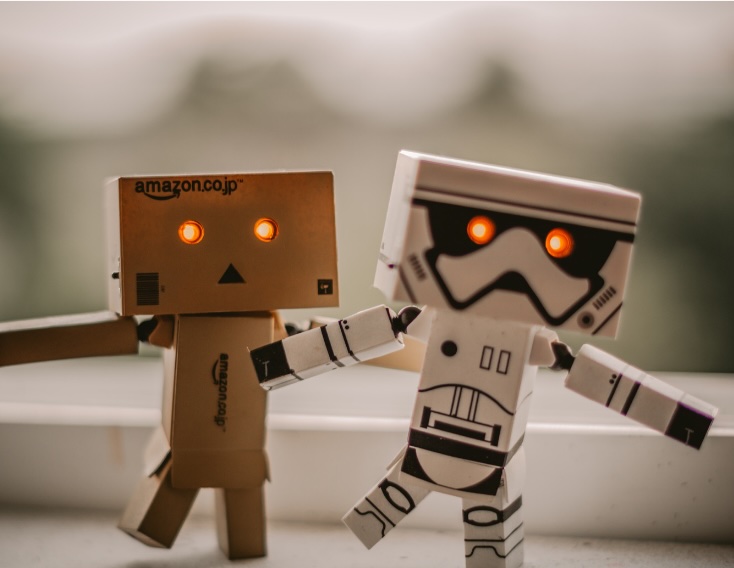
One of the joys of parenting is going down rabbit holes learning about what your child is interested in. One of my toddler’s special interests was blue robots.
As a woman with a STEM background, it was easy for me to get invested in this. At the same time, as a mom who worked in audio, I was always thinking about ways to bridge his interest into teachable moments about sound.
Robots were an ideal topic for this. There is a vast variety of robots (real and toys) – and a lot of creativity behind how they look, sound, and move. You can talk about concepts like quiet and loud, “high” sounds and “low” sounds, and sound localization (“where is that sound coming from?”) using robots.
Environmental sounds come easily because every robot can make sounds like beeps, blops, and whooshes. We used to make robot sounds a lot in our house – robot arms would click, clank, or beep. Robots always made a “boink” sound when they jumped. These kinds of verbalizations have been found to aide in speech development.
Books That Make Sound
In general, I’m not a fan of books with small speakers that make noises. Not only is the sound quality poor, but it takes away the opportunity to first use their imagination. The word “imagination” tends to be equated with story-telling, but it also could be a child’s ability to make up sounds or even their own words.
It’s widely stated that reading to children is important for language development and for early reading skills. But reading is also a bridge to listening and thinking about sound (on its own or in relation to visual art). Picture books have so much room for imagination – taking the words and pictures and turning it in to a sonic performance or experience. There’s always an opportunity to ask what a scene might sound like, if it’s loud or quiet, scary or calming. As kids get older, you can ask what kind of music might fit the story, and what sounds would support the mood the author is trying to shape.
All of this is building an awareness and vocabulary related to sound – not just perception, but emotional response to it.
Robot Books!
Here are a few of our favorites robot books:
- Robots, Robots Everywhere! is a Little Golden Book with TONS of different robots. It rhymes, it’s catchy, and there really are robots everywhere. This was by far the most-read robot book in the house.
- Robo-Sauce by Adam Rubin and Daniel Salmieri is a book we didn’t discover until post-toddler years, but it quickly became a favorite. The audiobook version (narrated by Adam Rubin) is well-done, as well.
- Little Robot Rabbit by Mike Brownlow is a board book with flaps – perfect for a two year old. It’s fun and cute but also a good book to use to talk about some emotions. (This book may easier found on the used book market.)
- Boy + Bot is the story of a boy who becomes friends with a robot until the robot stops working. It’s a nice-sized hardback book and would make a good gift.
- If I Had A Robot by Dan Yaccarino is a cute story from a boy’s perspective about what a robot could do for him (like eat his vegetables and kiss his Aunt Louise).